From the Perspective of the IGU Commission of Mountain Studies (CMS) & the Commission on Biogeography and Biodiversity (CBB)
Held on 11 December 2025
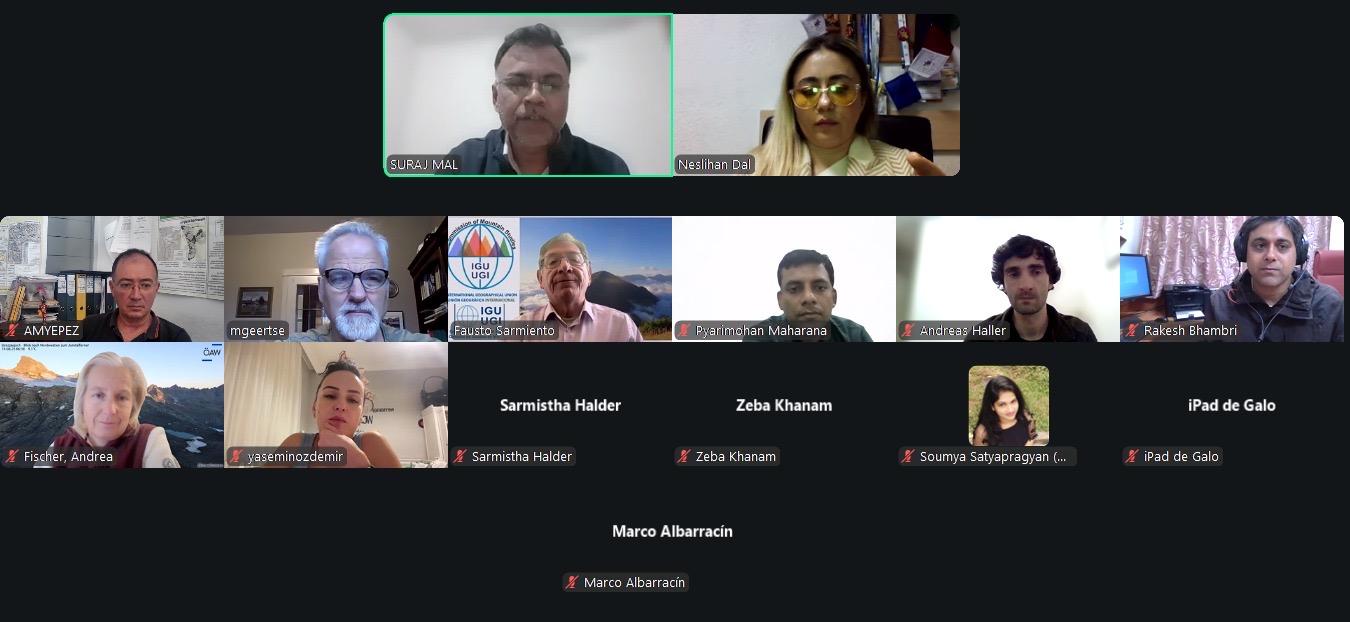
The International Mountain Day 2025 online seminar, jointly organized by the IGU Commission of Mountain Studies (CMS) and the IGU Commission on Biogeography and Biodiversity (CBB), was successfully held on 11 December 2025 with the participation of nearly 30 attendees from different parts of the world.
Designated by the UN General Assembly and observed annually on 11 December, International Mountain Day aims to raise awareness of the critical role mountains play for people and the planet. This year’s theme, “Glaciers matter for water, food and livelihoods in mountains and beyond,” provided a meaningful framework for the seminar, emphasizing the importance of glaciers within climate systems and the global implications of their rapid retreat.
The event opened with welcome remarks by Prof. Fausto Sarmiento, Chair of the IGU Commission on Mountain Studies, who introduced the concept of montology at the epistemological and ontological mountain frontier.
Session 1 – Recent Warming in Mountain Regions
Moderated by Dr. Suraj Mal, this session explored climate change impacts on different mountain environments:
- Dr. Pyarimohan Maharana presented on changing climates in mountain regions.
- Dr. Bob R. Nakileza discussed glacial change in East African mountains and related adaptation strategies.
- Dr. Rakesh Bhambri highlighted ground- and satellite-based glacier monitoring across the Himalayas and associated natural hazards.
Session 2 – Mountain Regions: Socio-Spatial Transformations and Environmental Change
Coordinated by Asst. Prof. Neslihan Dal, this session examined human–environment interactions and spatial transformations:
- Prof. Andrea Fischer shared insights on glacier recession and settlement dynamics, using geodata as a foundation for sustainable transformation.
- Prof. Andreas Haller addressed urbanization patterns and rural–urban linkages within mountainous landscapes.
Throughout the seminar, participants expressed great interest in the diverse range of case studies presented—from the European Alps to the East African Mountains and the Himalayas. Feedback highlighted that the discussions were highly informative, multidisciplinary, and valuable for strengthening international collaboration in mountain studies.
The CMS and CBB sincerely thank all speakers, coordinators, and participants for their contributions and support in organizing this meaningful event.