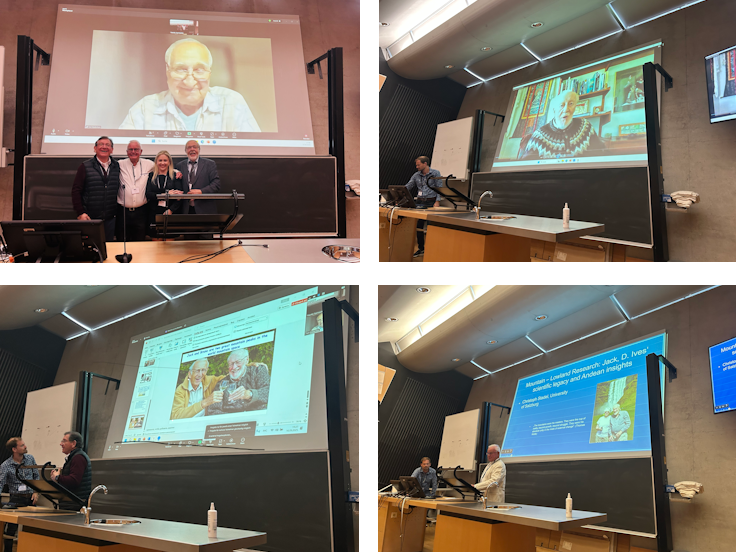
At IMC25, the IGU Commission of Mountain Studies (IGU-CMS) organized a special session dedicated to the memory of Jack D. Ives, one of the most influential mountain geographers of the 20th century. This session held deep meaning for our commission, as many CMS members presented their work in honor of a scholar whose vision shaped the global development of mountain studies.
Jack D. Ives was not only a pioneering scientist but also a committed mountain advocate whose interdisciplinary approach continues to guide research, policy, and international collaboration in mountain regions.
PS 3.107 — Montology in Memory of Jack D. Ives
Basic approaches, understandings, and methods of mountain researchers and studies
Jack D. Ives, a towering figure in mountain science, passed away on September 15 in Ottawa, Canada. This special session was designed to commemorate his extensive contributions to mountain research and to celebrate the intellectual legacy he leaves behind. The session revisited foundational concepts, ontological structures, and methodological approaches that continue to shape the field today.
Mountain landscapes have long been recognized as complex, interconnected systems. Alexander von Humboldt was among the first to conceptualize them this way, inspired by his 1802 ascent of Chimborazo in the Andes. This tradition was later carried forward by Carl Troll, who established the International Geographical Union Commission on High Altitude Geo-ecology in 1968—laying a foundation for modern mountain research by blending ecological, geographical, and anthropological insights.
Jack D. Ives took over the Commission’s chairmanship from Troll in 1972 and remained active until 1996. His leadership deepened global understanding of mountain environments and promoted interdisciplinary ecological work. In 1981, he founded the journal Mountain Research and Development and co-founded the International Mountain Society, significantly advancing the visibility of mountains in both research and policy worldwide. His advocacy for trans-disciplinary collaboration continues to shape the field today.
This special session aimed to revitalize the approaches championed by Ives—integrative, cross-cutting, and globally engaged perspectives on mountain systems and their challenges.
Presentations in the Session
The session featured contributions from several distinguished CMS members, each reflecting on the legacy of Jack D. Ives from different thematic perspectives:
- Axel Borsdorf – Jack Ives and Bruno Messerli in the line of Andean Montologist
- Neslihan Dal – The Legacy of Jack D. Ives: His Influence on Young Montologists Around the World and Reflections on Mountain Studies Today
- Fausto Sarmiento – From Geoecology, to Landscape Ecology, to Montology on the Shoulders of a Giant
- Christoph Stadel – Mountain–lowland research: Jack D. Ives’ legacy and Andean insights
- Yuri Badenkov – The Russian Chapter in Jack Ives’s Mountain Saga: Science Diplomacy, Friendship and Cooperation
His remote participation enriched the session with unique insights into the scientific diplomacy and long-standing collaborations that formed a crucial part of Ives’s global mountain engagement.
A Meaningful Gathering for IGU-CMS
This commemorative session at IMC25 not only honored Jack D. Ives’ extraordinary academic legacy but also strengthened the intellectual and emotional ties within the mountain research community. The reflections and presentations highlighted how deeply Ives shaped the principles, methods, and international collaborations that guide mountain studies today.
For IGU-CMS, this was more than a session—it was a tribute to the foundational figure whose work continues to inspire generations of researchers around the world. In this context, we would like to extend our heartfelt thanks to Dr. Alton C. Byers, Dr. Carol Harden, Dr. Teiji Watanabe, Dr. Seth Sicroff, Prof. Dr.Thomas Hofer, and Dr. Martin Price. Their invaluable insights into Jack Ives’ academic career and generous sharing of knowledge greatly enriched our presentations and added profound value to our discussions, highlighting the lasting impact of Jack’s contributions on the field.